
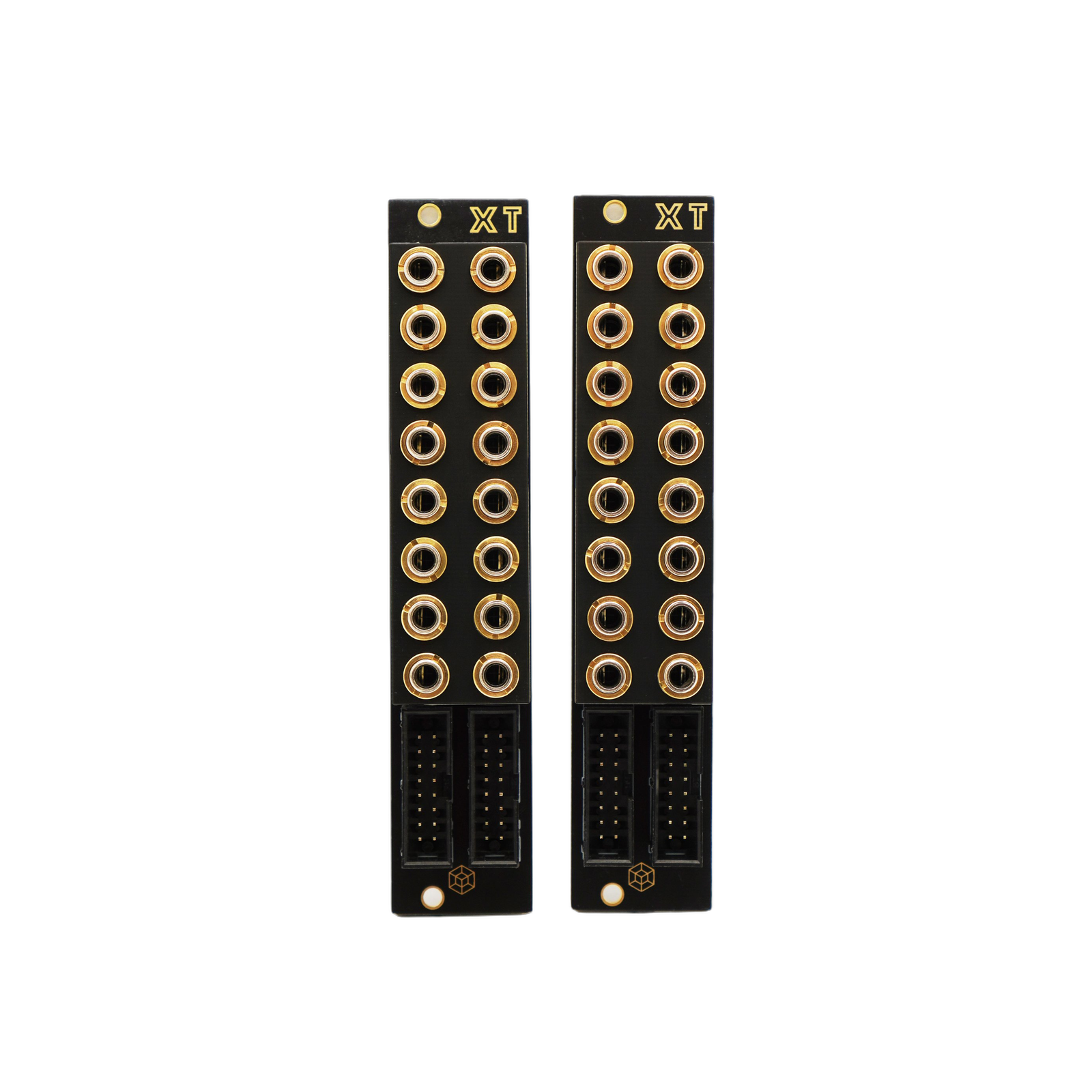
Remote extension module that allows to connect 16 signals (audio, CV, gate or whatever) between large or separated cases.
To avoid bleeding, signals are isolated with a ground line between them (both in the ribbon cable and the printed circuit).
The bundle consists in two XT modules and two ribbon cables ( 1 m ).
Size: 5 HP
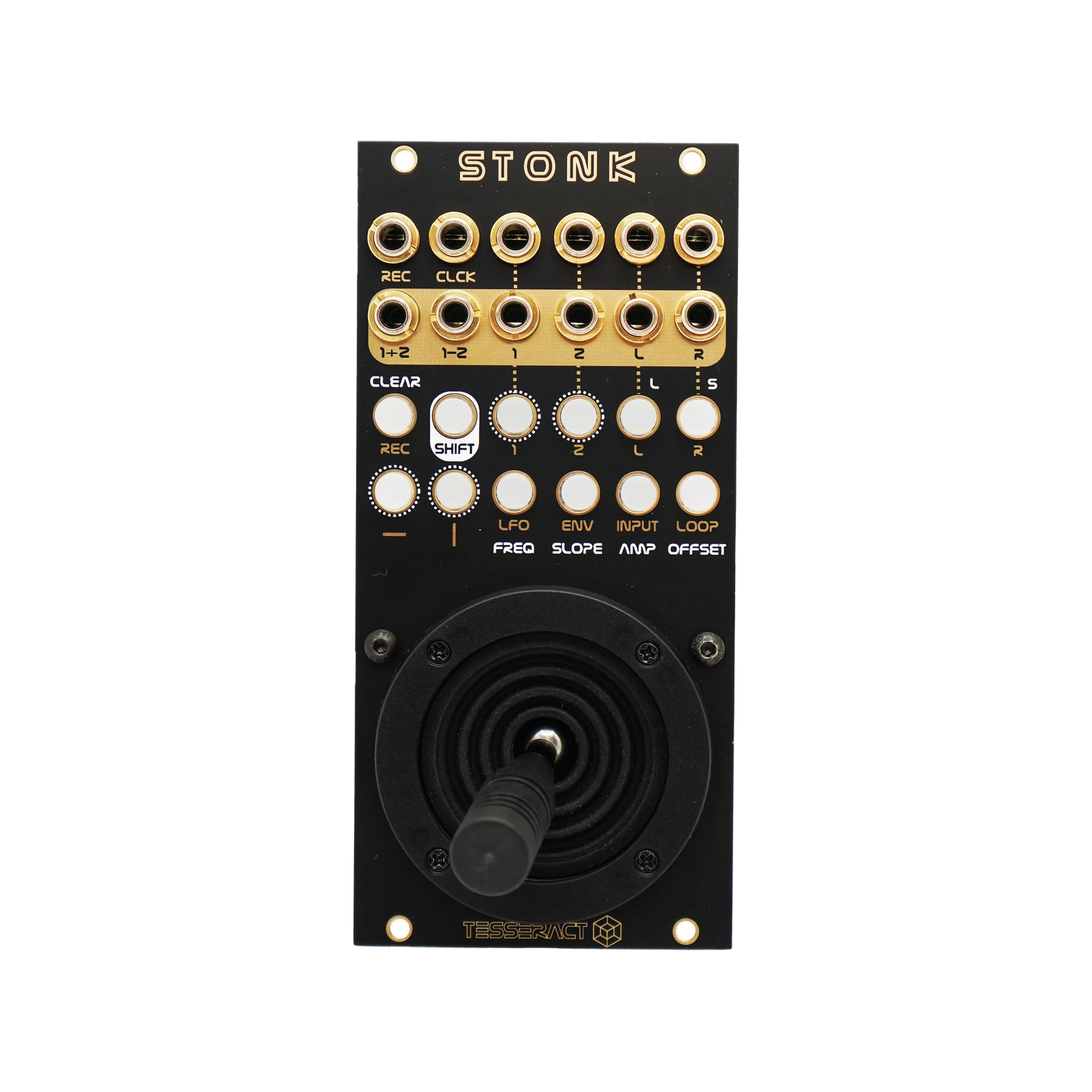
STONK is a joystick controller and looper with 2 channels of CV and 2 of audio. It’s also a CV generator & audio processor.
Features:
2 audio in & out (AC coupled)
2 CV in & out (DC coupled) ±5V
2 extra CV outputs ±10V (analog sum and difference of CV outputs 1&2)
12 illuminated push buttons
CV & Audio looper (150 seconds per channel)
LFO
Euclidean envelope generator
Multimode Filter
Stereo Reverb
Wave Folder
VCA
The audio AD/DA is 24 bit, 48 KHz, the internal audio handle is 32 bit float.
The CV AD/DA is 16/12 bits, 12 KHz.
Each channel has 6 modes available. By default 2 parameters are assigned to the horizontal & vertical axes but this can be easily tweaked, so it’s possible to control any of them (frequency, symmetry, offset or amplitude of the LFO, for example) not only with the joystick but with the 2 CV inputs.
The polarity control & offset of every parameter can also be modified on every mode and every channel.
6 presets for store and recall not only the joystick assignment and settings but all the parameter values for all modes and channels.
Size: 12 HP
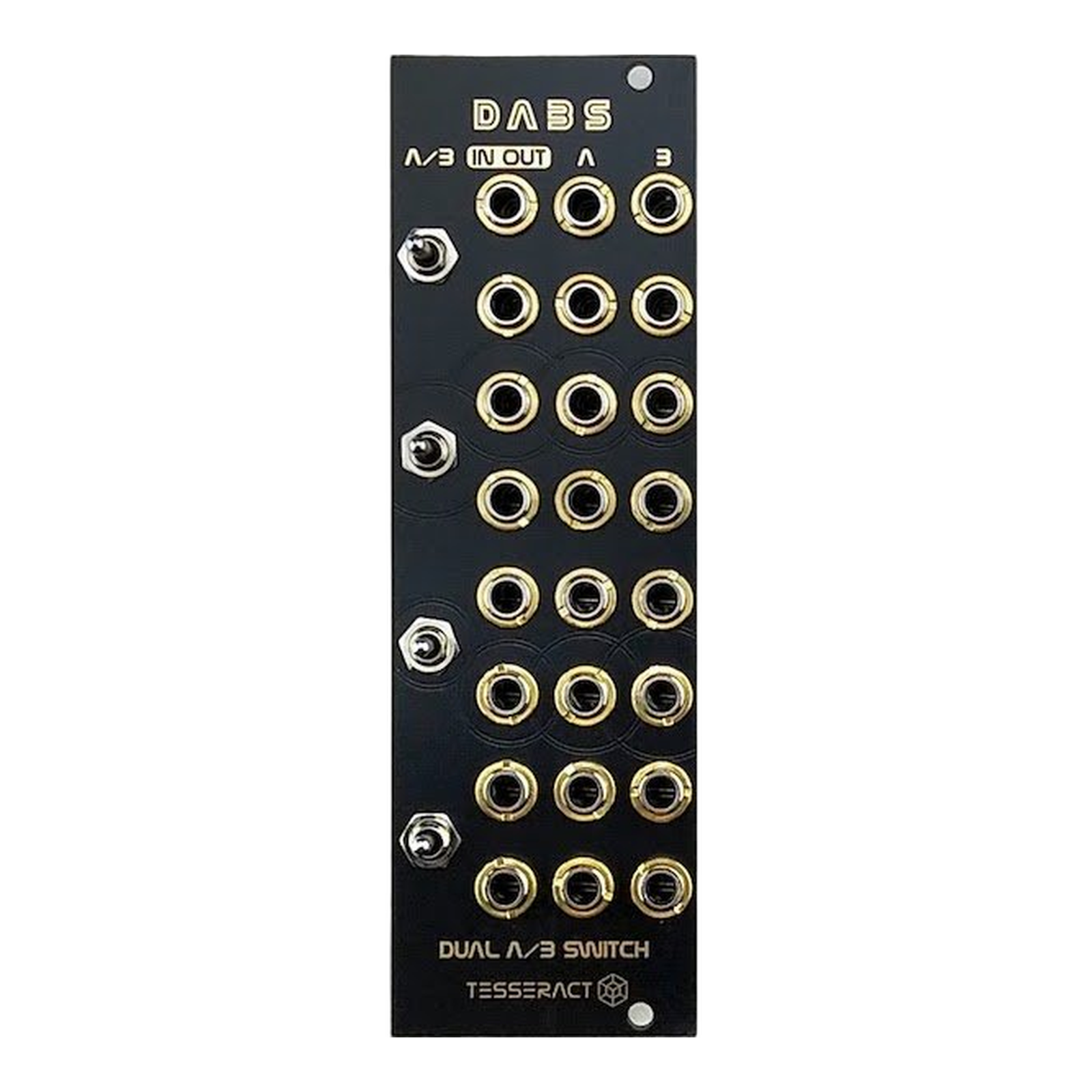
The A/B Switch selects between A and B and the middle position of the switch is a "mute", works with any kind of signal (cv or audio) and is bidirectional.
This is an utility module that I made for switching stereo signals, but other uses are possible:
Select between 2 stereo sources.
Select between 2 stereo destinations.
Bypass control for mono signal processing.
Routing control for a single signal.
Panel is reversible so it can be mounted with the switches on the right or left.
Size: 8 HP
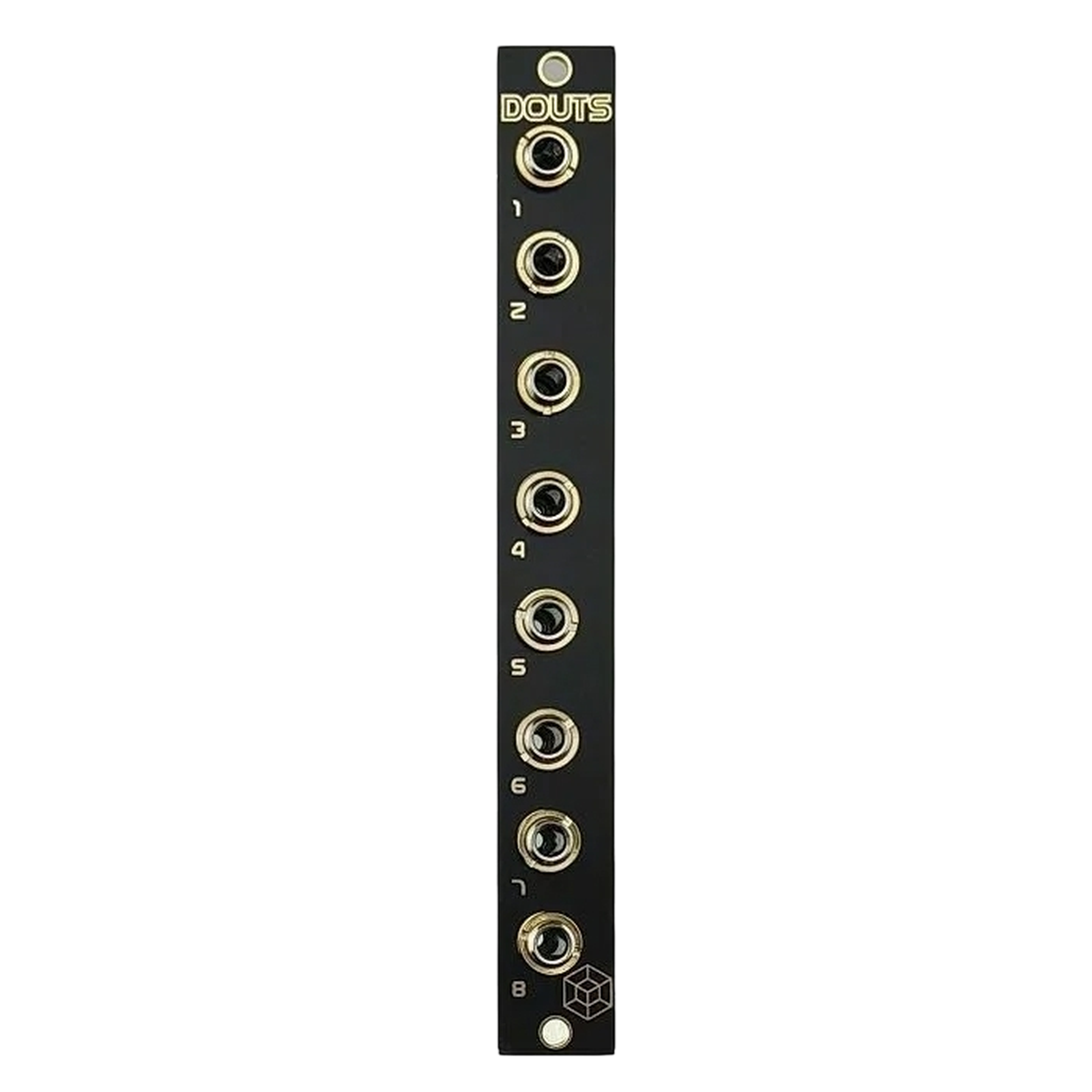
This is a 3HP version of the Douts module,
a breakout box for the direct outs of the TexMix. Valid for '4StereoChannels' and '4MonoChannels' version 1.5 & 1.6, for earlier channel expander versions some DIY would be required (check this).
Each module has 8 outputs so it could have 2x '4MonoChannels' connected or 1x '4StereoChannels'.
The orientation of the 8 pin ribbon cable is marked by the 'DIRECT OUTS' legend on the PCB of the channel expanders (mono or stereo) and a white line in the DOUTS input header.
DOUTS has 3 headers on the back, 2 of them are for 4 Mono Channels, the other one, labeled STEREO, is for 4 Stereo Channels.
Size: 3hp
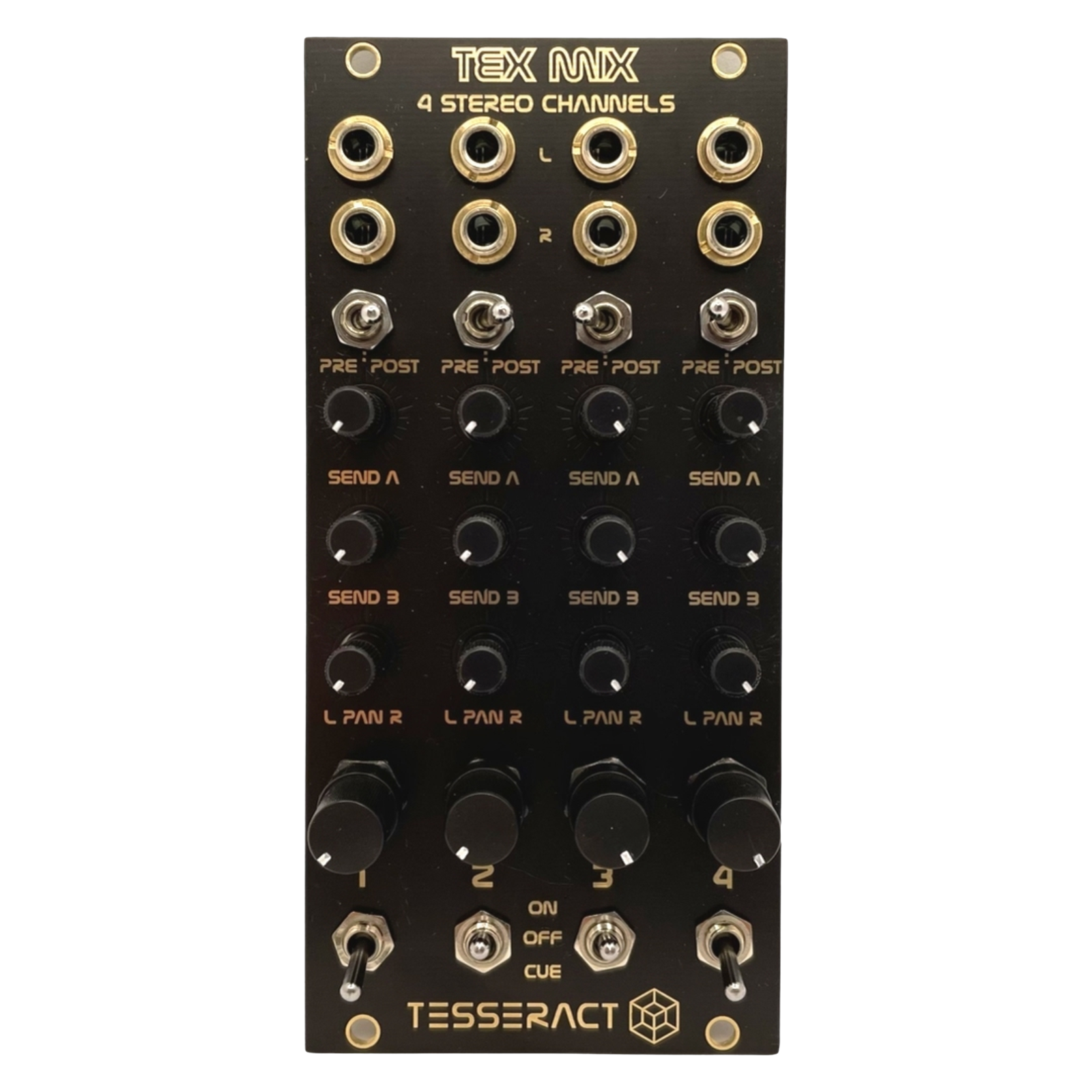
This is a 4 stereo channels expansion. Several of this modules can be added to get more stereo channels.
Every channel features:
Stereo input (L works as mono in)
SEND A control (switchable PRE/POST, in PRE mode the signal is present regardless to the ON/OFF/CUE switch position and channel volume control)
SEND B control (post-fader)
PAN control (only affects the master bus)
VOLUME control (affects the master, cue and POST sends)
ON/OFF/CUE switch:
ON- channel is routed to the master bus
OFF- channel is muted
CUE- channel is routed to the cue bus
15 mA +12V
15 mA -12V
Size: 12hp
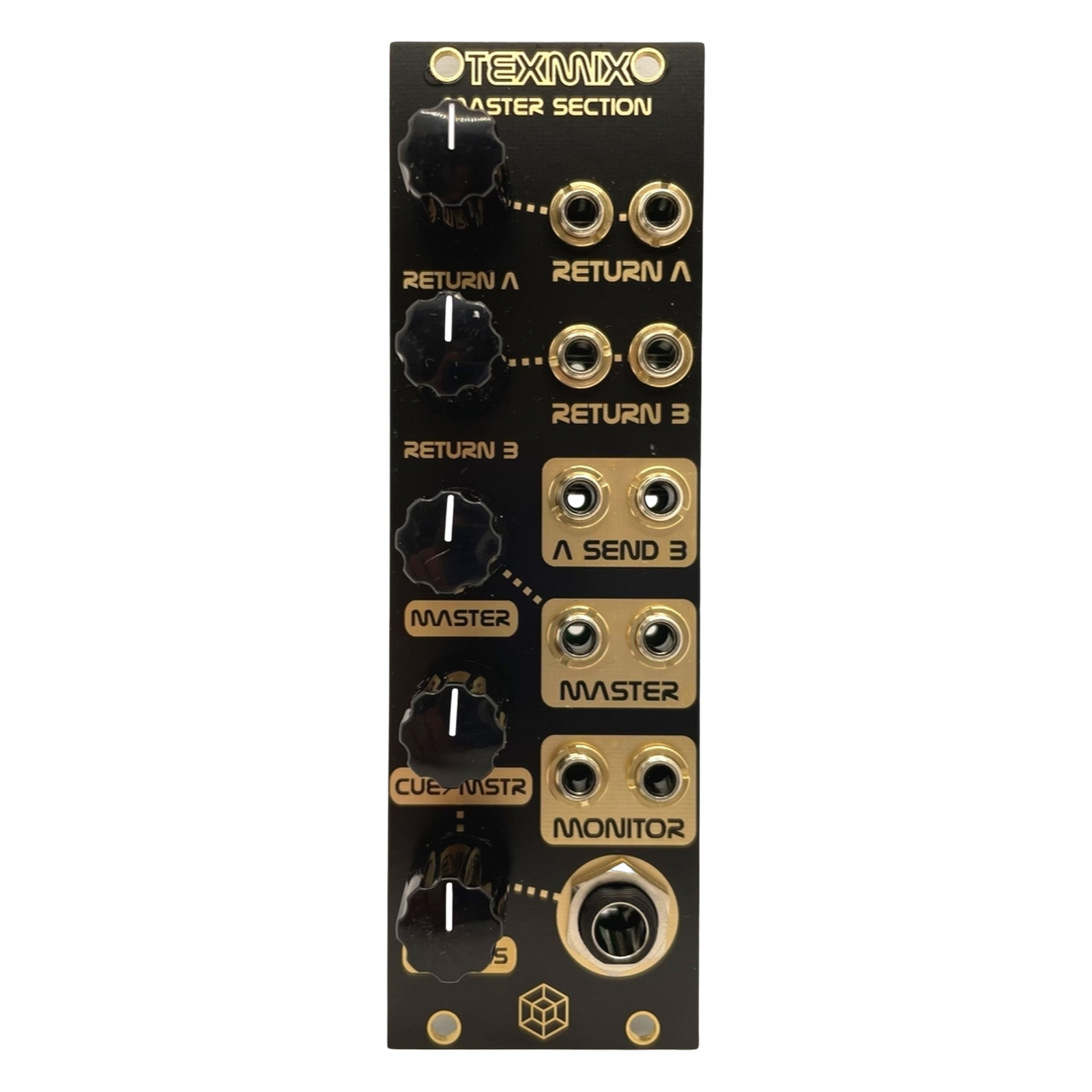
This is the main module of the mixer and the only indispensable one, the only one that needs the eurorack power cable. It provides power to all the other modules and contains the summing circuit for all channels in every audio bus.
Features:
- 2 Stereo aux returns A and B with dedicated volume control (2 stereo inputs)
- SEND A aux out
- SEND B aux out
- Master stereo output with dedicated volume control
- Monitor stereo output (configurable for CUE only out or CUE/MASTER out with jumpers on the back)
- CUE/MASTER balance pot (mix control for the headphones and, if so desired, the monitor out)
- Headphones output with dedicated volume control
-Return A can be configured for modular or line level gain, so it can be used with Strymon pedals, non eurorack effect processors or synths
-Bus outs with pin headers on the back to connect the vu meter BLINKS (master pre-fader, master post-fader, cue, sends A&B)
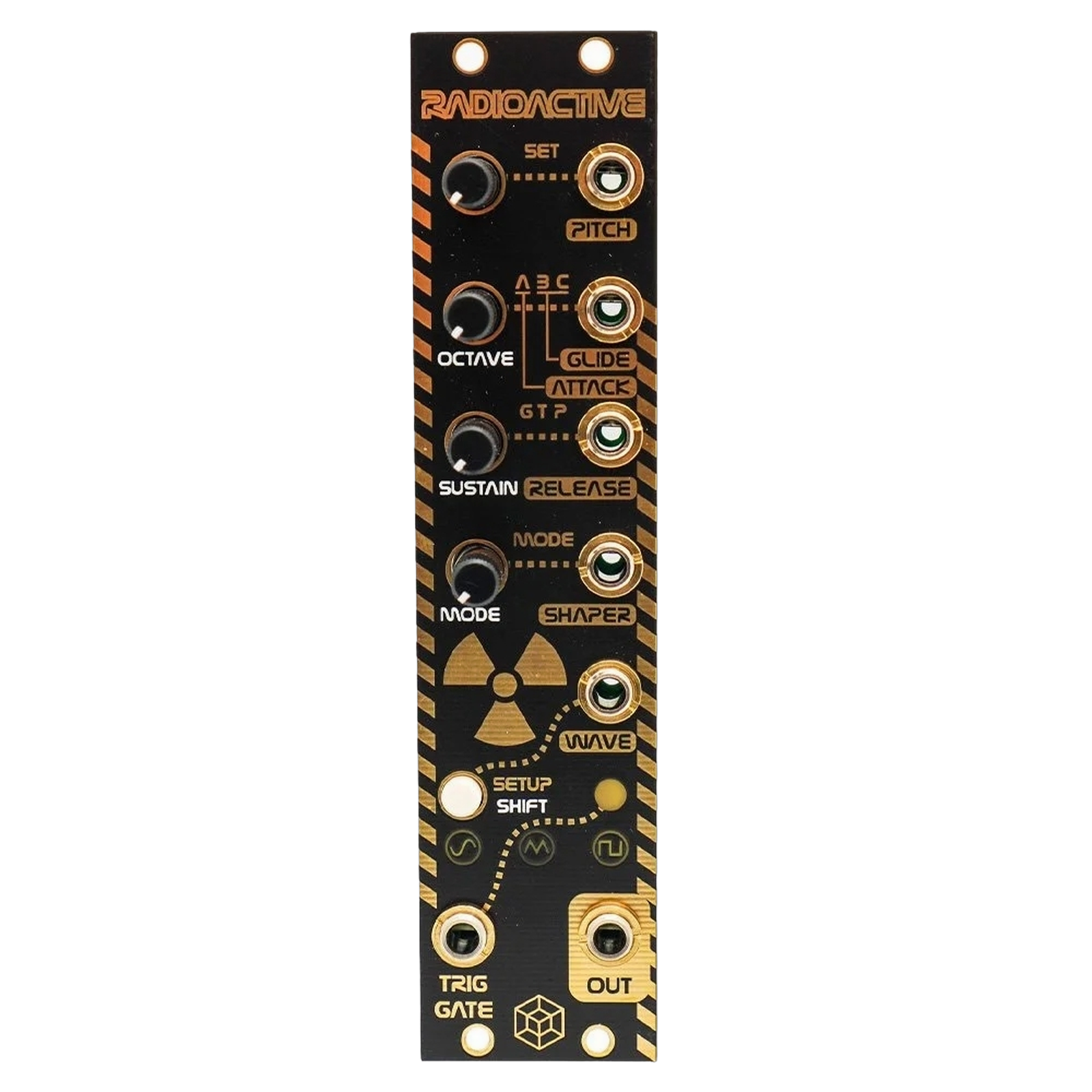
Radioactive is a small but powerful 14-bit analog modelling voltage-controlled digital sound source: a complete voice Eurorack module in 6HP. It consists of 3 simultaneous independent oscillators, voltage-controlled AR/ASR transient generator, voltage-controlled pitch slew (glide) and voltage-controlled waveshaper with 5 different modes, but that's just the beginning. Its forte consists of selectable gate/trigger/constant envelope timing signals, rather unique 3-voice polyphonic mode, semitone-quantized mode, voltage-controlled waveform selection, on-the-fly selectable 10Vpp CV input range with offset (except for Pitch), a few experimental features, and then some.
Under the hood, it's a chiptune-inspired wavetable-gnawing sound cruncher with a mind of it's own, and oh boy it's dirty. It could be described as raw and untamed, but it would probably be an understatement.
Operation
V/Oct Pitch input with attenuator
3 CV inputs with offset (Glide/Attack, Release, Shaper)
Trig/Gate input for envelope triggering/gating
Wave change trigger input
Single button with 3 different functions: waveform change with short press, shift function (alternate control parameter) with long press, enter setup mode on power-up.
3 green illuminated indicators of selected waveform and their combinations, also providing information in setup mode
Single red illuminated indicator of incoming trigger or high/low gate signal
Simple and intuitive setup without menu diving (parameters are saved and recalled at start-up)
3 different operation modes (A, B & C) selectable in setup:
A - Free range oscillator with Attack and Release envelope
B - Free range oscillator with Release envelope and Glide
C - Quantized oscillator with Release envelope and Glide
3 different envelope activation modes (G, T & P) selectable in setup:
G - Gate mode, monophonic
T - Trigger mode, monophonic
P - Poly mode, 3-voice polyphonic
5 different wave shaper modes selectable in setup and at runtime
9 basic waveforms and 12 different combinations
Specifications
VCDO sound source with thousands of possible waveform shapes
All inputs: 100k impedance, 512Hz DC rate
32kHz refresh rate
14-bit sound generation
10-bit CV capture
V/oct input range: 0 to +5V (C1-C6 with octave shift control to cover the entire C0-C8 range)
CV input range: on-the-fly selectable 0 to 10V, -5 to +5V or any other 10Vpp range between -10 and +10V
Trig/Gate input range: 0 to +10V (0V closed, 3V+ open), protected
Output levels: -5V to +5V (10Vpp), envelope/shaper mode dependable
Professionally designed front panel with all linked functions clearly labeled in different colours
42 mA +12V
10 mA -12V
0 mA 5V
25 mm deep
Radioactive 1.2 does not require calibration, do not flash it with 1.1 firmware (unless you like magic smoke)
links:
Firmware Radioactive 11r01.zip:
https://www.dropbox.com/s/xqmxl1jrqjoce9i/Radioactive%2011r01.zip?dl=1.
Radioactive v1.1 BOM.xlsx:
https://www.dropbox.com/s/ahb5o40z0nuuf4v/Radioactive%20v1.1%20BOM.xlsx?dl=1
Radioactive v1.1. Build guide:
https://drive.google.com/open?id=1e3fh5Ky4Uqqt0wBZhjzI9mP86zWRSHtg
Radioactive v1.1. User guide.pdf:
https://www.dropbox.com/s/wk55gvgzy63afj0/Radioactive%20v1.1%20User%20guide.pdf?dl=1.
Tesseract Radioactive 1.1. ibom.html:
https://www.dropbox.com/s/7moykgm94qwymyh/Tesseract%20Radioactive%201.1%20ibom.html?dl=1
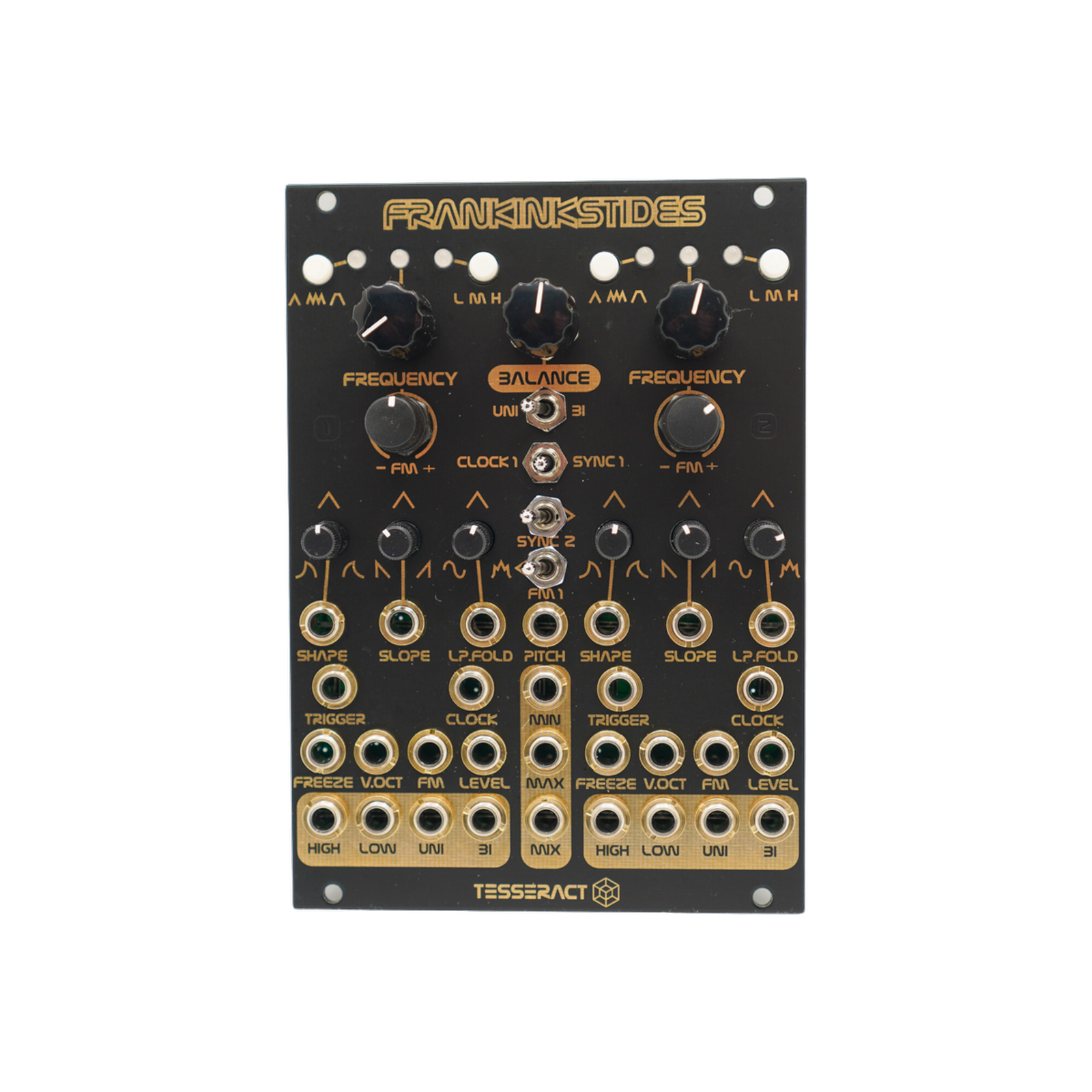
FranKinksTides is a 18hp dual Tides (based on the Swirls pcb layout) with the max/min circuit from Kinks and some switches for sync, quadrature, pll and FM operation . It can be a double/complex oscillator, a dual function generator or any combination of oscillator, LFO and Envelope generator with lots of cv control plus some interesting cross-modulation and sync features.
FranKinksTides is a dual digital waveform generator providing both single-shot and cyclic operation modes, and covering a very wide range of frequencies from 0.5mHz to 10kHz. As such, it can serve as an AD or AR envelope generator, a LFO, or an audio oscillator. Its unique design allows the waveform to be controlled along 3 dimensions: curvature of the rise and fall segments (shape), relative timing of the rise and fall segments (slope), and harmonic content (smoothness).
some improvements in version 1.2:
-Mix output is now buffered, no signal bleeding on single outs.
-Mix pot controls also the balance of the signals sent to the max/min circuit.
-Uni/bi switch now also determines the signal sent to FM1.
-Clock/sync switch has now a center OFF position, no need of plugging a dummy cable in the Clock1 when using Sheeps firmware to avoid ultra fast sound bank changes.
Manual and more details here.
original design by Émilie Gillet
Size: 18hp
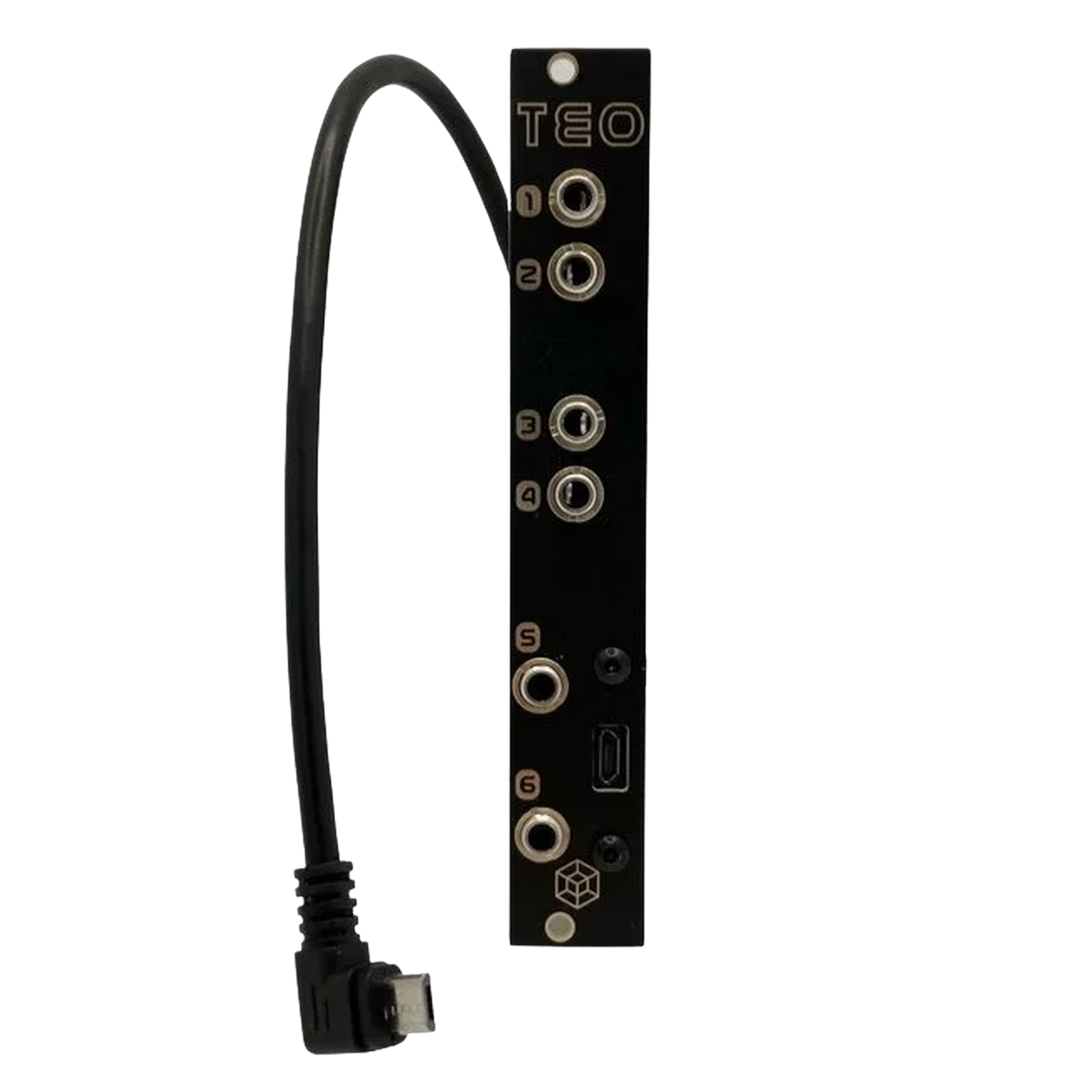
This module it's an expander for the trigger sequencer TUKRA.
Features 6 additional audio outputs for single channel processing and USB for MIDI in & out (midi class compliant device) to connect with Ableton, Cubase, Logic or any other DAW.
Easily configurable for envelope, LFO and stepped CV (pseudo v/oct) instead of individual audio track output.
TEO support was implemented in Tukra's firmware 1.05. Earlier versions will output nothing.
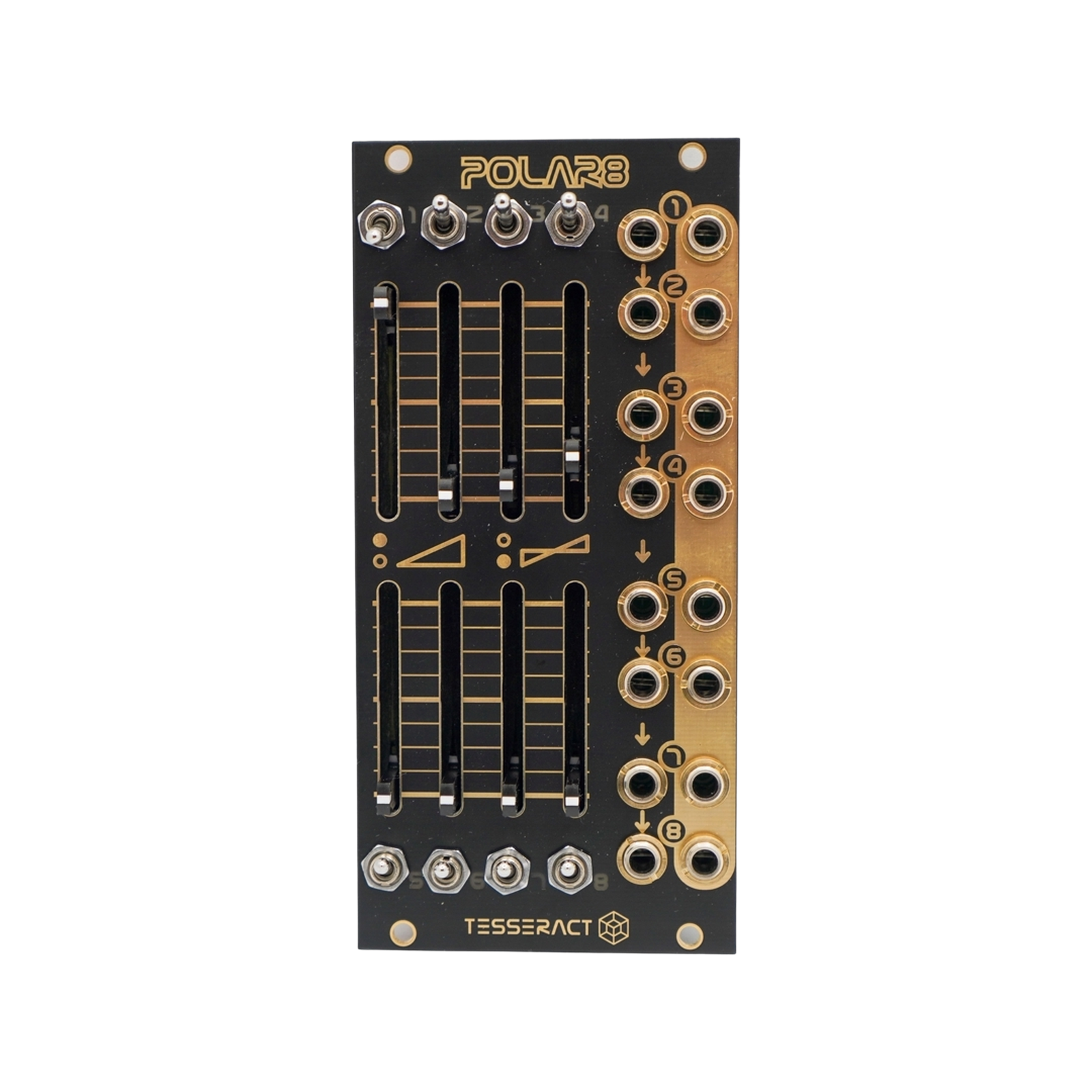
8 Channels of attenuator / attenuverter
Toggle switches to set the channel as attenuator (up) or polarizer (down)
First channel is normalized to a reference voltage (can be 5 or 10 volts, configurable in the back of the module)
Each input (except first) is normalized to the previous one, providing different versions of the same CV source.
Bicolor leds
55 mA +12V
55 mA -12V
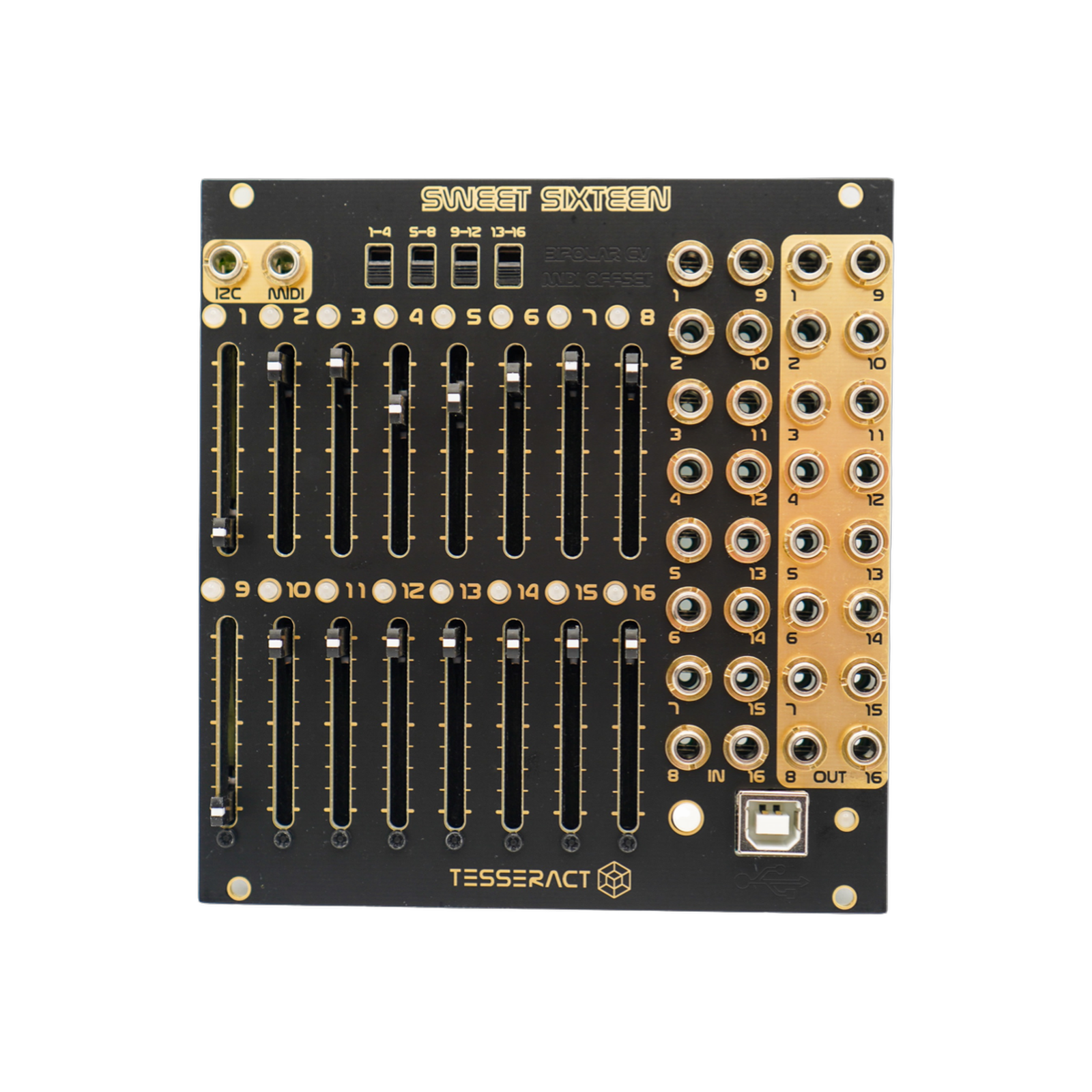
This module is a eurorack version of the 16n Faderbank, implemented with 16 CV inputs and some other smart add ons. Almost everything is in the front panel.
This new version is oriented for firmware tweaks and future expansions, still being fully compatible with the 16n and the previous Sweet Sixteen.
Features:
Midi trs out
Jumpers on the back to swap between 'Arturia/Novation' and 'Korg/Makenoise' Midi trs standards
USB Midi out (usb midi class compliant device)
4 switches to enable bi-polar CV to Midi/i2C conversion (one for every 4 channels)
i2C via mini jack on front panel and pin header on the back of the module.
16 inputs
16 outputs
16 faders
16 bi-color leds to show what's going on in every channel
The Midi CC number and channels can be different for the TRS jack and the USB port. The firmware has been tweaked to allow also Pitch Bend, which is pretty handy because you can get much better resolution through Midi (from min to max values Midi CCs have 128 steps and Pitch Bend has a resolution of 16.384 steps).
Midi CCs, midi channels, fader calibration and i2c master settings can be customized with the web editor.
The voltage generated by every fader is up to 8v, which is good enough to control eurorack modules (like wide open/close the cutoff frequency of a filter etc).
In the midi CC messages, 0 volts will correspond to a value of 0, and 8 volts to a value of 127. But the CV to Midi can handle also negative voltages, for such task there are 4 slide switches (1 for every 4 faders) that swaps the internal voltage reference in a way that, when activated, 0 volts will be the middle position of the midi controller, -4 volts the minimum value and +4 volts the maximum. Those switches only affect the Midi/i2C outs, CV outs won't be affected by them in any way.
If you plug in a bigger voltage source (like a -5v+5v LFO or a 10v envelope) the fader will work as attenuator, so you'll be able to adapt how that signal affects the Midi CC out, covering the whole Midi CC range, saturating the waveform or just affecting it briefly.
Panel USB port is type B, which seems to be stronger than mini or micro ones.
i2C could connect directly to an ER-301, monome Ansible or a monome Teletype.
The Teensy can be powered via the internal regulator or the +5v eurorack rail (selectable via a switch on the back).
Changes from previous versions:
Function push button (for GESS presets)
Function led
Expansion header in the back
i2C pull-up switchable with jumpers (aux pcb not required)
Mate black & gold panel with brass nuts
There are 16 channels, which can be used as:
Midi controller
Manual CV generator (0 to 8v range)
Attenuator
CV to Midi CC
i2C controller
CV to i2C data
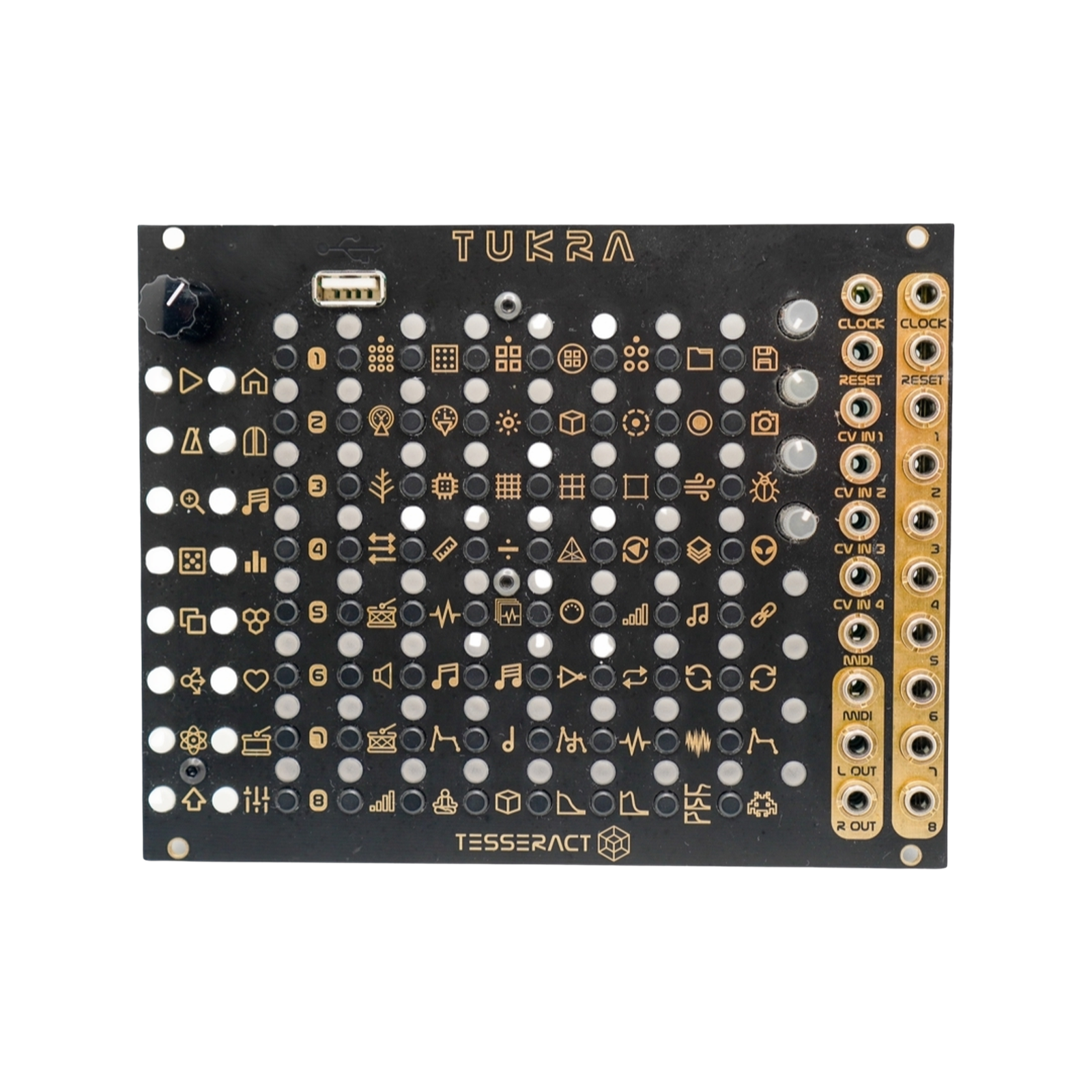
Introducing Tesseract Tukra, the ultimate digital drum machine and sequencer for your Eurorack modular synthesizer system. Packed with features and loaded with versatility, Tukra is sure to become a go-to tool for any musician or producer looking to add complex rhythms and dynamic percussion to their music.
With 8 trigger/gate outputs, 4 CV inputs with offset potentiometers, audio L/R outputs, and MIDI in/out/through ports, Tukra is equipped to seamlessly integrate into any setup. And with a built-in drum synth, noise generator with envelope, and sample player, you'll have plenty of options for shaping and sculpting your drum sounds.
But Tukra isn't just about drum sounds - it's also loaded with a mixer, various effects, a modulation matrix, and tools for generating and manipulating rhythmic patterns. Plus, with a live view mode and various performance-oriented features, Tukra is perfect for on-the-go performances or spontaneous jam sessions.
A quick rundown:
Each project can include up to 64 steps, 64 patterns, 64 parts, and 16 songs. The microSD card holds 64 projects.
Play mode, clock divider, length & choke settings are independent per track & pattern.
Step value (can be used for modulation, to define the midi velocity, midi note & drum synth pitch or sample selection).
32 HP
Ins & outs:
8 trigger/gate, clock & reset outputs. Clock & reset inputs.
4 CV inputs with offset potentiometers (so they’re manual controls when no CV is plugged in).
Audio L & R out (6 additional ones with the expander for independent track output).
Front panel midi TRS in & out, and USB host for midi controllers.
Midi and audio:
Midi note and channel configurable per track & song, midi note and velocity can be set by the step value.
Drum synth, noise with envelope and ‘one shot’ sample player (factory and user banks) per track.
Flexible sample selection (each track can play up to 128 samples).
Mixer with volume, balance, reverb, bit crusher, filter cutoff, resonance and type (smoothly crossfades LP - BP - HP).
Modulation:
CV & assignable midi CC plus 8 internal LFOs, 3 stepped random sources and step value.
Modulation matrix for almost all parameters.
Rhythm variation:
Probability for step, gate and roll.
Euclidean Rhythm Generator.
‘Ramifications’ generative tool.
Live view with solo, mute, fill, roll, invert pattern, reverse play direction and rotate.
Time:
High precision internal clock source and low latency.
External synch (via trigger, midi TRS or USB).
Triplets and swing (aka ‘shuffle’), triplet and swing can be generated from a straight clock input or midi clock.
Micro grid edit, each step has 6 micro steps (24 ppq).
Half and double tempo functions.
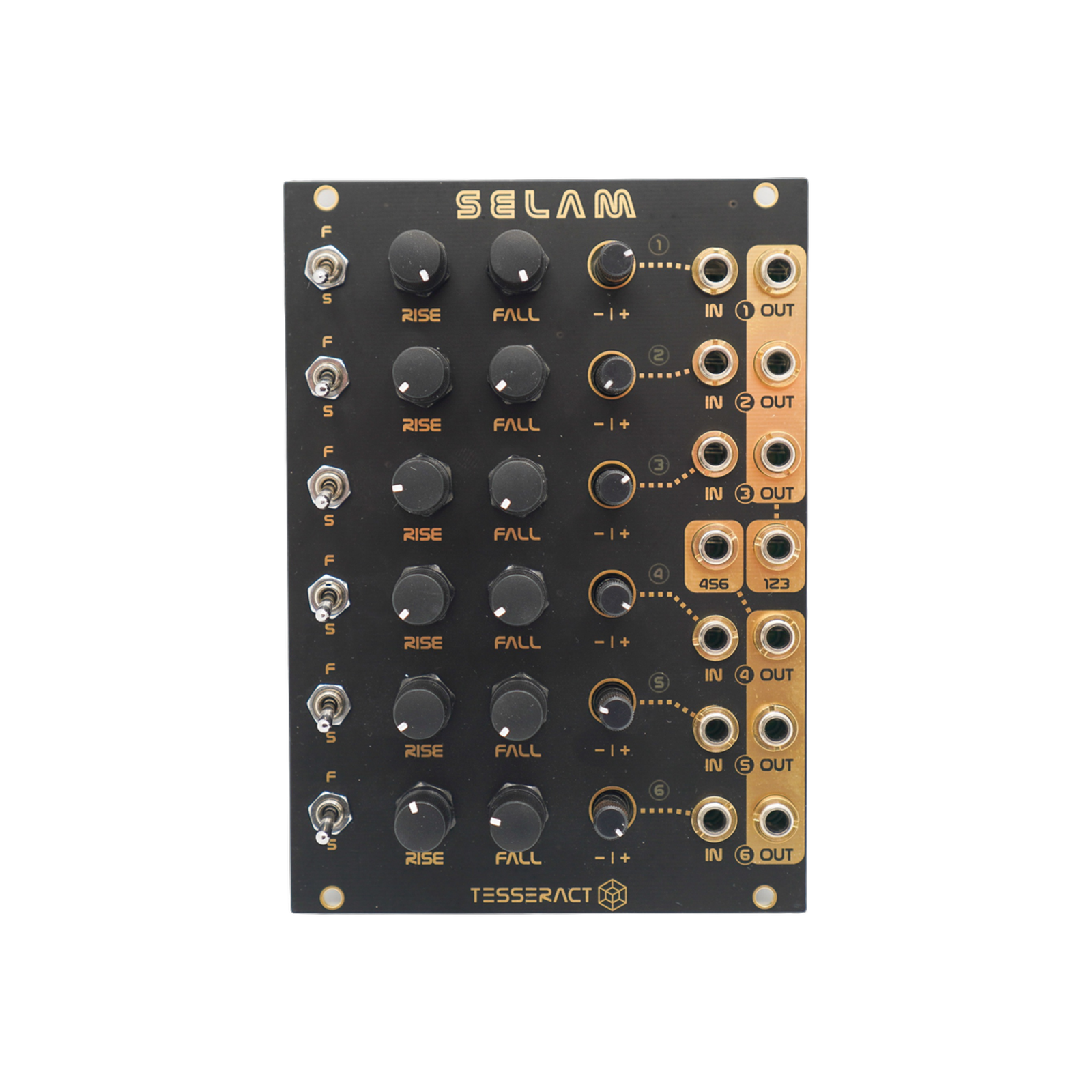
This module is a 6-channel function generator.
Each channel has an attenuverter to set the output gain, there are 2 extra outputs with mixed signals (channels 1+2+3 and 4+5+6) for complex CV.
-With no signal plugged in the input, channel will self-oscillate generating an LFO of ±4,8V
-With gate/trigger signals in the input, channel is an AR envelope generator
-With a stepped CV signal plugged into the input, the channel acts as a slew limiter
min attack/decay time:
0,3 milliseconds in fast mode
13 milliseconds in slow mode
max LFO length:
1" in fast mode
1'20" in slow mode
max attack/decay length:
13" in fast mode
3'00" in slow mode (approx)
159 mA +12V
153 mA -12V
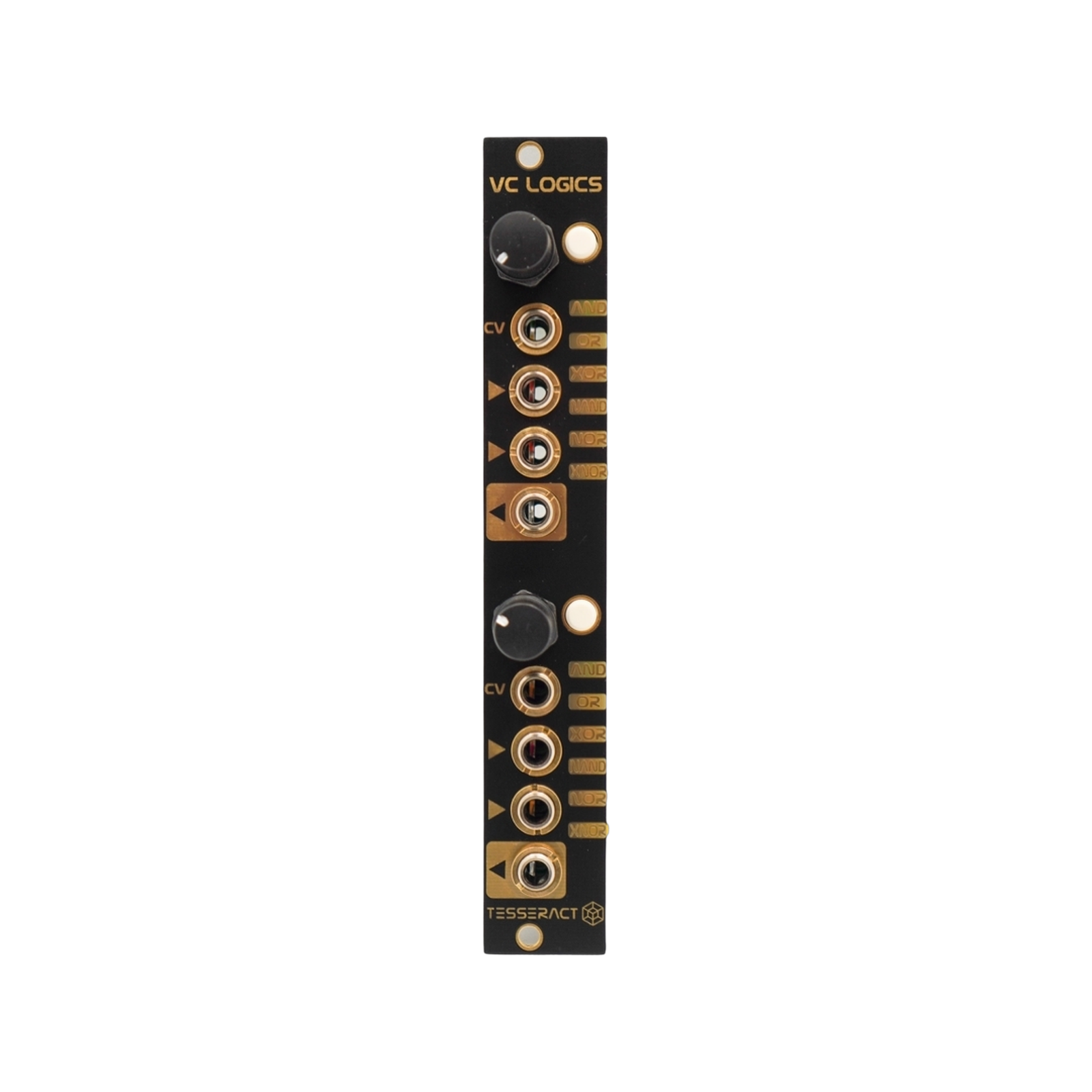
2 x Logic gates with voltage controlled boolean function selection
Logic gates are used in order to combine GATE signals to conditional event. For example it can be used to combine the GATE signals from various sequencers to get different patterns.
The module has 2 logic processors, the boolean function can be selected with the potentiometer, the CV input or the push button. The CV input range is 0 to 8V, but the potentiometer will work as an offset, so for example, placing the pot in the center position will allow the use of bipolar ±4v CV sources like LFOs etc. The input is protected so voltages over 8v will be trimmed out.
Each processor can work in 2 modes:
-Free: when the boolean function changes the output changes according to the inputs & logic type.
-Quantized: when the boolean function changes the output won't change until there is a change in any of the inputs, that way you won't get out of time beats when using the module for percussions with and LFO in the CV input ...for example.
To change the mode long press the button (1 second) if the mode you've just entered is the 'free' one you'll see a pattern on the leds.
CV input 1 can be set to be a trigger input with a jumper in the back of the module, to work just like the push button, so any incoming trigger will jump to the next boolean function, those functions are:
AND
OR
XOR
NAND
NOR
XNOR
42 mA +12V
10 mA -12V
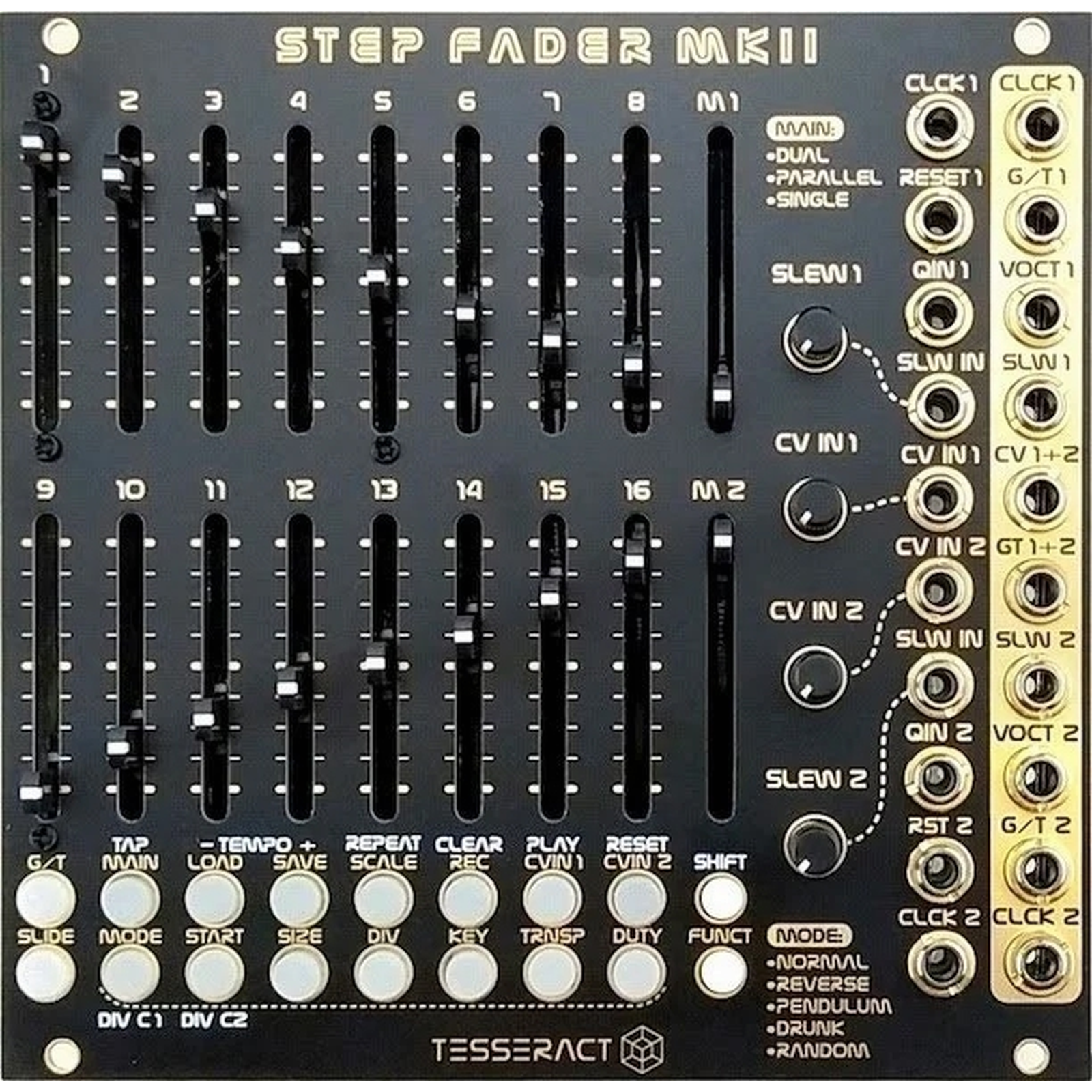
Step Fader mkII it’s a ‘hands on’ eurorack dual sequencer, featuring two 8-step lines or one with 16 steps, plus quantizer, slew limiter, internal clock generator, CV inputs to control any parameter, and more…
Each sequencer has independent settings for the play mode, start point, size (length), clock divider (or step repeat), transposition, and duty cycle.
There are 16 presets to store & recall all the above settings plus CV input assignment, scale, tempo, step repeat, and clock-out ones.
The 2 channels of the quantizer can be used for processing external signals, same for the slew limiters.
The 16 illuminated buttons can be used to set several parameters, even to play the sequencer as a keyboard.
There are 3 MAIN SETUPS:
• DUAL (2 totally independent 8-step sequencers)
• PARALLEL (one sequencer with 2 rows of CV and 8 steps)
• SINGLE (one sequencer with 16 steps)
There are also these PLAY MODES:
Normal
Reverse
Pendulum
Drunk
Random
Each sequencer features:
Clock input (clock input 1 is normalized to clock input 2)
Clock output
Reset input
Gate/Trigger output
Slew limiter output (unquantized)
V/OCT output (quantized)
Additionally, there are 2 summing outputs:
Gate/Trigger 1+2 (OR output of both G/T)
CV 1+2 (sum of both slew limiters)
Features 2 CV inputs with offset pots. Assignable parameters are mode, start, size, clock divider, key (the position of the sequencer is controlled by CV), transposition, and duty cycle.
Size: 26 HP
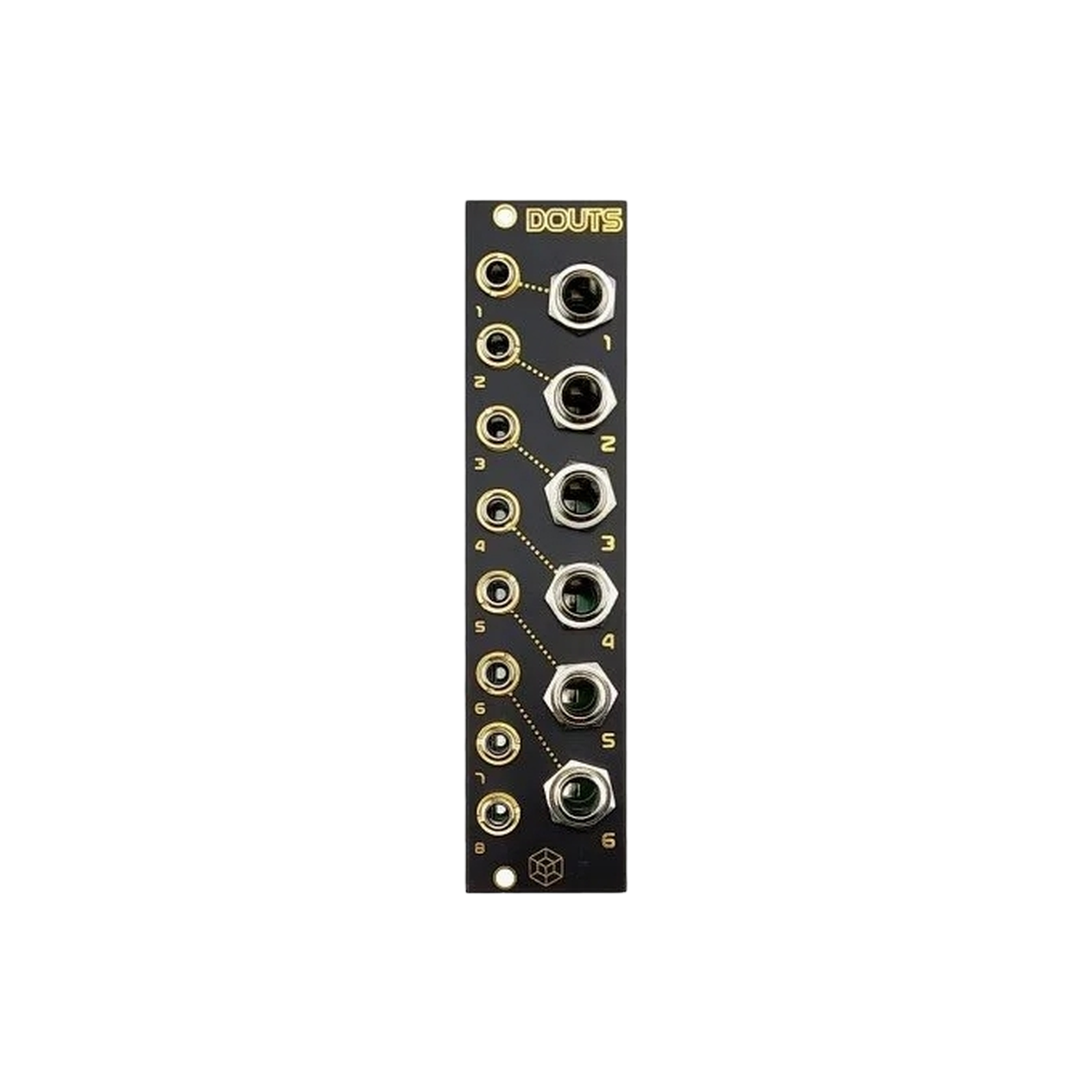
This is a breakout box for the direct outs of the TexMix. This is valid for the '4 Stereo Channels' and '4 Mono Channels' version 1.5 & 1.6, for earlier channel expander versions some DIY would be required (scroll down). Please note that if you bought your Stereo or Mono channels expansion in our shop - it’s already the latest version.
Each module has 8 outputs so it could have 2 '4 Mono Channels' connected or 1 '4 Stereo Channels'.
Without connecting the ribbon cable it's a 3,5/6,3 adapter.
the orientation of the 8 pin ribbon cable is marked by the 'DIRECT OUTS' legend on the PCB of the channel expanders (mono or stereo) and a white line in the DOUTS input header.
DOUTS has 3 headers on the back, 2 of them are for 4 Mono Channels, the other one, labeled STEREO, is for 4 Stereo Channels.
Size: 6hp
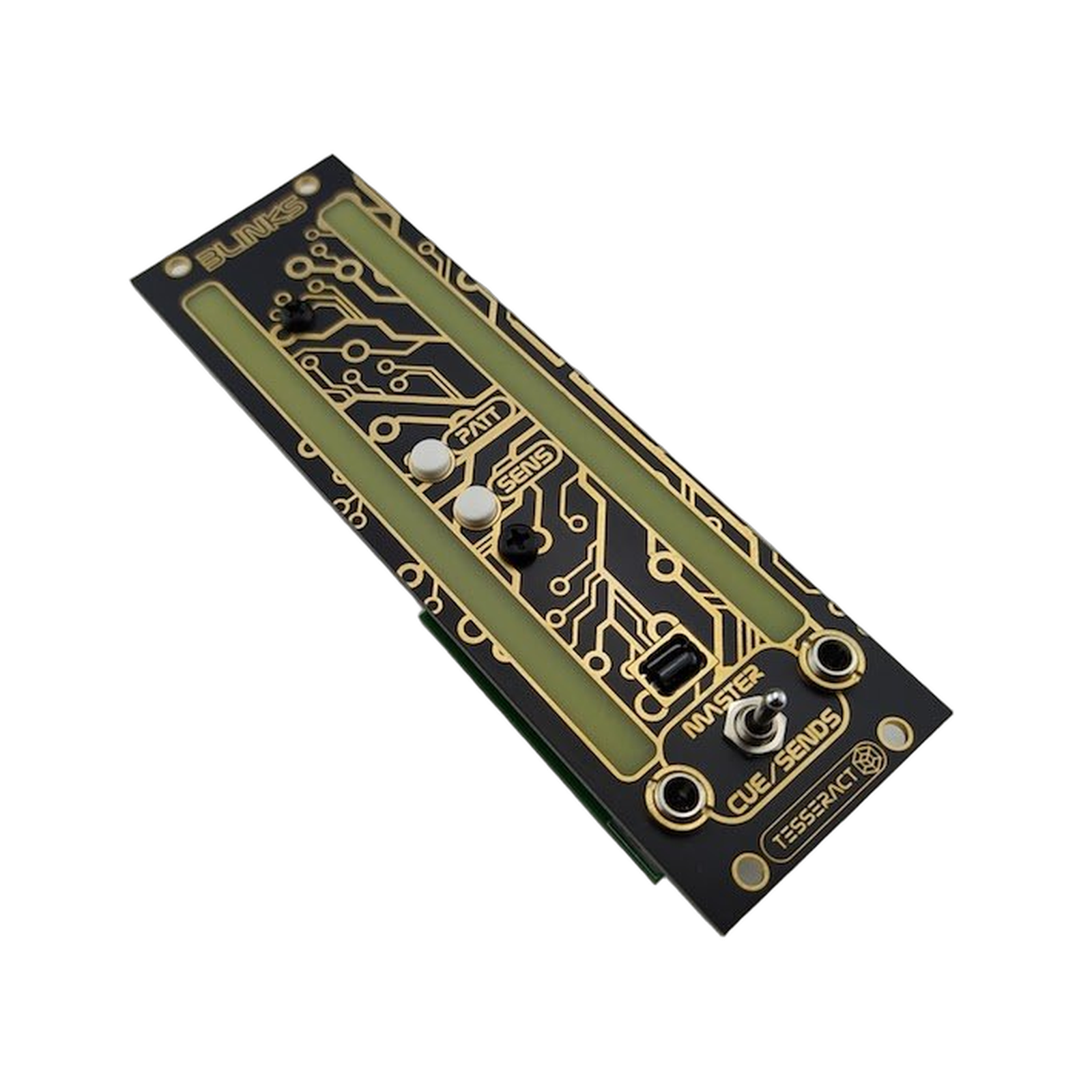
BLINKS is a VU meter for eurorack with 24 RGB leds per channel, function is pretty easy, it has 2 inputs, one for each led column (no output btw).
PATT button changes the led pattern ( 6 patterns to choose ).
SENS button changes the input sensitivity, cycling in 7 steps.
Long pressing the PATT button enters the color scheme selection.
Long pressing SENS button enters the brightness adjustment. Most probably you'll prefer the lowest setting.
The module has a 5v regulator in case you don't have 5v in you eurorack PSU. A jumper in the back select if the led board would be powered by the 5v rail or the internal regulator (which works with the +12v rail)
Up to 3 stereo signals can be connected to a buffered input using the rear headers.
Easy DIY with only a few components, the led board is already assembled.
The manual can be found here: https://docs.google.com/document/d/1tdMeC9nqjF0h6hIbVZVO91IQMDsViXZGZKPKW6ChAM8/edit
Size: 8hp
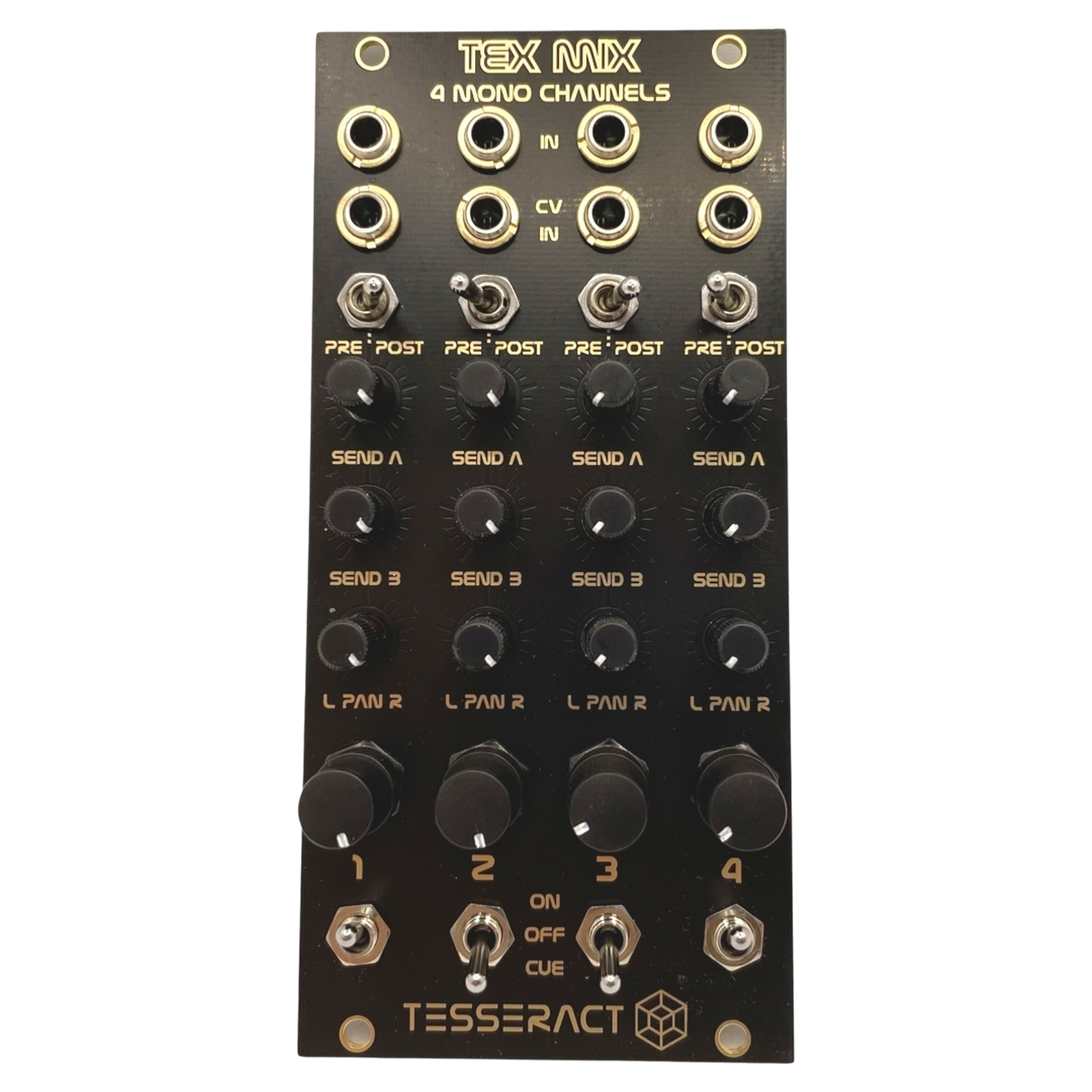
This is a 4 mono channels expansion. Several of these modules can be added to provide more channels. Every channel features:
- Mono input
-Linear VCA (only versions 1.5 & 1.6, previous version has a Vactrol Gate)
-SEND A control (switchable PRE/POST, in PRE mode the signal is present regardless to the channel volume control but only if the channel switch is in ON position)
-SEND B control (post-fader)
-PAN control (only affects the master bus)
-VOLUME control (affects the master, cue and POST sends, does not affect PRE-fader send)
-ON/OFF/CUE switch:
ON - channel is routed to the master bus
OFF - channel is muted
CUE - channel is routed to the cue bus
-Header for direct outs (only versions 1.5 & 1.6)
Size: 12hp
Manual: https://docs.google.com/document/d/1vae1EN4fMGtUhlCPmYTmMSbE-9Ip4i1NLRefINSQALA/edit?usp=sharing
Vinia is a new powerful 8-channel audio generator and processor for Eurorack. Each channel is independent and has its own signal chain. This can be a multi-engine instrument, an FX processor, a combination of both, or a chain of several FX.
The sound generator section offers 2 sample players (one plays from the 16 MB internal flash memory and the other directly from the microSD card), various VCOs (VCO, multi-VCO, harmonic VCO), Karplus, a Chord generator, noise, a drum synth and modulation generators (LFO, envelope follower, envelope).
Each of these generators has a rich set of parameters for setting up your sounds. Then, there is a powerful multi-FX processor.
Tesseract Modular has added 20 different algorithms in Vinia: FM operator, filters (multimode, ladder, rubber, bandpass), a wave folder, tube saturation, delays (filter delay, delay, long delay), reverb, metallizer, grain pitch shift, and more.
These can be flexibly set in a chain per channel and offer many customization possibilities. The module also hosts a mixer. You can also save your channels in presets and work with macro parameters.
Each of the 8 channels can be independently configured as a multi-effect processor, VCO, sample player…
8 Channels
6 Audio inputs (AC coupled, tracks 7 & 8 use inputs 1 & 2)
8 Audio outputs (DC coupled)
8 trigger inputs
8 CV inputs (-5V / +5V)
Midi TRS input
2,4” color display
LFO, envelope, envelope follower, and mini sequencer per channel
The module can be used both with jacks up or down.
Audio outputs are DC coupled so it can be used to generate complex CV modulation sources too.
There are 2 types of modulation in Vinia, the first is stepped (occurs every 1,4 milliseconds approx.) and very flexible, any modulation source can modify any parameter of any track. The second is the ‘audio rate’ one (44,1 KHz), only a few parameters admit this type and both sources and destinations will be within the same track.
Audio sources:
Audio Input
Flash Sample Player
MicroSD Sample Player
VCO
Multi VCO
Harmonic Oscillator
Karplus
Chords
LFO
Envelope Follower
Envelope
Noise
Drum Synth
Audio processors:
FM Operator
Multimode Filter
Ladder Filter
Rubber Filter
Bandpass Filter
VCA / Polarizer
Folder
Tube Saturation
Exponential Envelope
Delay
Filter Delay
Long Delay
Long Filter Delay
Reverb
Metalizer
Chorus
Modulator
Vocoder 16
Vocoder 32
Bit Crusher
Rectifier
Grain Pitch Shift
Ring Modulator
Size: 16 HP