
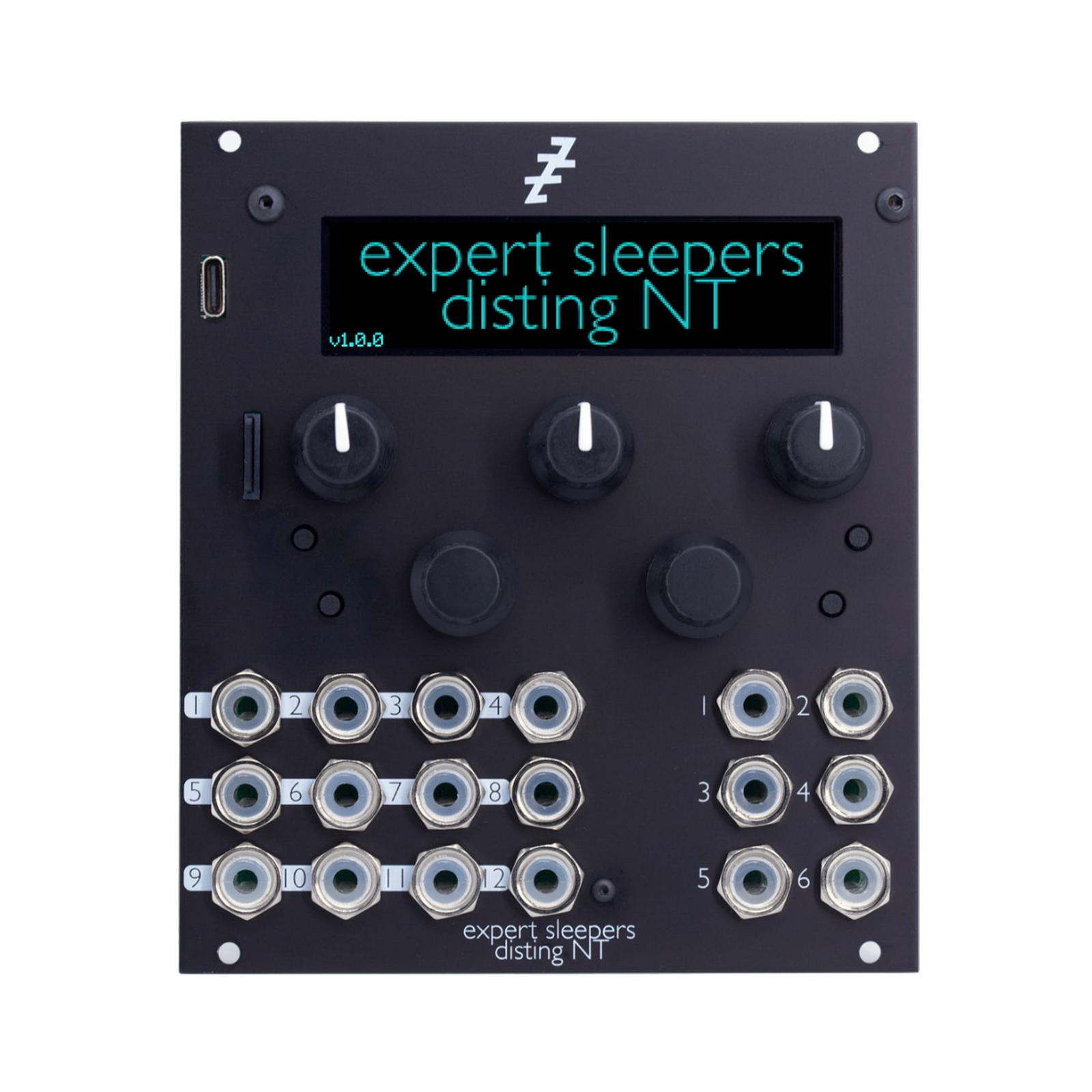
Introduction
The disting NT is the latest in the line of modules from Expert Sleepers that started with the original disting in 2014, which performed one of 16 very different functions at the turn of a knob. This concept has evolved through the disting mk3 (2015) - which added the possibility of firmware updates, and so a continually improving selection of functions - and the disting mk4 (2017) - which added a display, and brought the MicroSD card slot onto the front of the module, emphasising its increased importance for functions such as sample playback - to the disting NT’s predecessor, the disting EX (2020).
Ever since the mk3 was released, the modules’ firmwares have been continuously updated with new features, making them even more useful and better value.
We aim to continue this legacy with the disting NT.
Whereas the disting EX built directly on the selection of functions in the mk4, and then added some of its own, with the disting NT we’ve taken everything back to square one. We anticipate (eventually) adding every function ever offered by the previous distings, but every algorithm has been reconsidered and reappraised in the light of the possibilities offered by the new hardware platform. Often things have been streamlined and simplified - for example, a disting EX algorithm that offered a polysynth, a chorus, and a delay would be implemented on the NT as three separate functions, which you could combine as you choose - each function therefore being smaller and easier to deal with.
While the exact future of this module is yet to be written, one thing is certain - it will be driven by user feedback. We have an active user community, and suggestions made by users have often made it into the firmware. So we strongly encourage you to get in touch! Let us know what the disting NT can be for you.
What does it do?
The module takes audio and/or CV input, runs a bunch of software processing, and generates audio and/or CV output. It does this continuously.
The chunks of software processing are called algorithms. You can think of them much as you would think of plug-ins in your DAW. The module has a number of algorithms to choose from, and you can add the ones you want in a big list and the module will run them all.
What is it not?
The disting NT is not a “virtual modular”. There are no virtual cables flying around. It simply collects together a variety of functions that are useful in the context of a modular synthesizer and makes it possible to use a number of them at once.
It is not a “patch player”. It is not the intention that you do all the complex setup on a computer and then copy it over to the module. The module is designed to be used in a modular, with a UI that makes it fluid to do everything in the module itself.
It is not only useful via MIDI. The large number of inputs (and outputs) makes it possible to use it entirely via CV, interfacing with the rest of your modules in a natural way. (That said, it does also make a really good MIDI polysynth.)
Many-in-1 multifunction module
THE disting mk4
The mk4 builds on the previous mk3 and adds these new features:
- a dot matrix display, making menu navigation, parameter selection etc. a breeze.
- a front panel accessible MicroSD card slot.
- compatibility with the Macro Machines Storage Strip.
- an internal precision clock allowing new algorithms such as a tuner, and pitch and frequency references.
The new version is largely software-compatible with the mk3, and the intention is to continue releasing new features for both the mk3 and mk4 in parallel.
X & Y inputs, A & B outputs:
ADC: 24 bit, THD+N -93dB, Dynamic range 99dB, SNR 99dB
DAC: 24 bit, THD+N -94dB, Dynamic range 105dB, SNR 104dB
Sample rate: 75kHz
Z input sample rate: 75kHz
CPU: Microchip PIC32MX at up to 50MHz, hackable, open source code framework available.
Functions:
There are currently 84 distinct algorithms organised in several banks.
The first 16 are the 'classic disting' ones.
Precision Adder with integer voltage offsets
Four Quadrant Multiplier with integer multiply/divide
Full-wave Rectifier
Minimum/maximum
Linear/Exponential Converter
Quantizer with selectable scales
Comparator with adjustable hysteresis
Dual Waveshaper wavefolder and triangle-to-sine shaper
Sample and Hold with noise source and adjustable slew rate
Slew Rate Limiter with linear and exponential slew
Pitch and Envelope Tracker
Clockable Delay/Echo
LFO with through zero frequency control and waveshaping
Clockable LFO with multiply/divide and waveshaping
VCO with linear FM sine and saw outputs
VCO with waveshaping saw/triangle and pulse outputs
The remaining algorithms are:
Precision Adder with fractional voltage offsets
Voltage Controlled Delay Line vibrato/chorus/flange effects
Clockable Ping Pong Delay
Clockable Ping Pong Delay with input pan control
Resonator for drum synthesis
Vocoder 12 band
Phaser up to 10 stages
Bit Crusher
Tape Delay with voltage controlled tape speed
Waveform Animator
State Variable Filter smoothly variable filter type
LP/HP Filter
LP/BP Filter
BP/HP Filter
BP/Notch Filter
AR Envelope
AR Envelope (with push)
AR Envelope & VCA
AR Envelope & VCA (with push)
Dual AR Envelope
Dual AR Envelope (with push)
Euro to Buchla Converter
Buchla to Euro Converter
Clockable AD Envelope (with mute)
Clockable AD Envelope (with gate)
Clockable AD Envelope (with trigger)
Clockable AD Envelope & VCA
Shift Register Random CVs
Shift Register Random Quantized CVs
Shift Register Random Triggers
Shift Register Random Dual Triggers
ES-1 Emulation
ES-2 Emulation
Pitch Reference
Frequency Reference
Tuner
MIDI Clock
MIDI/CV
CV/MIDI
Crossfade/Pan
Dual Sample and Hold
Dual Quantizer (Z scale)
Dual Quantizer
Dual Euclidean Patterns
Dual Delayed Pulse Generator
Noise
Programmable Quantizer
Stereo Reverb
Mono-to-Stereo Reverb
Dual Reverb
Stereo Chorus
Mono Chorus
Gate
Delayed LFO
Scaled LFO
The functions relating to playing back audio and MIDI files from the MicroSD card are:
Audio Playback
Clocked Audio Playback
Audio Playback with V/Oct
Audio Playback with Z Speed
Audio Playback with Reverse
Dual Audio Playback
Dual Audio Playback with Z Speed
MIDI File Playback (Clocked)
MIDI File Playback (Free Running)
Audio Playback with End CV
Audio Recorder
Wavetable VCO